An unexplained artefact is not an object about which nothing is known. Usually a great deal is known: the alloy, the approximate date, the layer of earth or the wreck it came from. What remains is a narrower gap, and the honest work is describing exactly how narrow. This file examines three objects with genuine open questions, then two famous claims that collapsed under testing.
The Antikythera mechanism
Partly open In 1901, sponge divers working a Roman-era shipwreck off the Greek island of Antikythera recovered lumps of corroded bronze. Only later were they recognised as parts of a geared device. Eighty-two fragments are now held at the National Archaeological Museum in Athens.
Find history: National Archaeological Museum, Athens; Derek de Solla Price, Gears from the Greeks (1974).
Price used early radiography to propose that the device modelled astronomical cycles. From 2005 the Antikythera Mechanism Research Project applied X-ray computed tomography and surface imaging, recovering thousands of characters of inscribed text that work almost like a user's guide. The well-supported functions include predicting eclipses through the 223-month Saros cycle, tracking the 19-year Metonic cycle, and displaying the timing of panhellenic games including the Olympics.
Source: Freeth et al., Nature (2006); Freeth et al., Nature (2008).
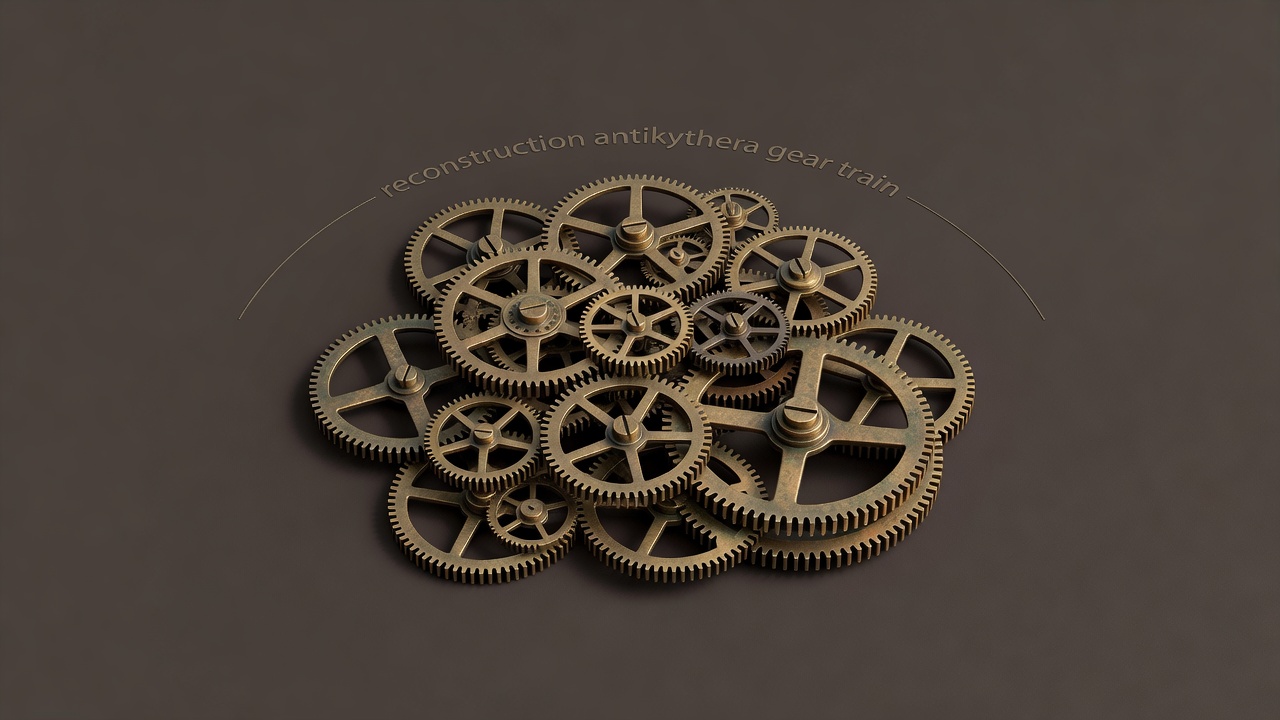
The open questions are specific. Most of the front planetary display is lost, so any model of how it showed the five planets known in antiquity is a reconstruction. A team at University College London published one such model in 2021; it fits the surviving inscriptions but cannot be confirmed without missing parts. The maker is unknown, and the manufacturing date is debated, with estimates commonly falling in the 2nd or 1st century BCE.
Source: Freeth et al., Scientific Reports 11 (2021).
What the gap does not mean: uncertainty about the planetary display is not evidence of lost super-technology. The device fits within Hellenistic astronomy as recorded in Greek and Babylonian sources; what surprises is its mechanical sophistication, not its knowledge.
The Phaistos Disc
Open In 1908 the Italian archaeologist Luigi Pernier excavated a fired clay disc, about 16 cm across, at the Minoan palace of Phaistos in southern Crete. Both faces carry a spiral of signs pressed into wet clay with individual stamps, which makes it an early example of reusable type. There are 45 distinct signs and around 242 sign impressions. The disc is displayed at the Heraklion Archaeological Museum.
Source: L. Pernier, excavation reports (1908–09); Heraklion Archaeological Museum catalogue.
The obstacle is quantity. No other text uses the same sign set, and a single short inscription offers too little repetition for statistical analysis to test a proposed reading. Dozens of "decipherments" have been published; none can be verified, because any of them can be fitted to so few signs. A minority view, argued notably by Jerome Eisenberg in 2008, holds that the disc is a modern forgery; most specialists accept it as genuine, but thermoluminescence testing that might settle the matter has not been permitted.
A text with no partner and no repetition is not a puzzle awaiting a clever mind. It is a sample too small to test.
Riddle Garden Frenzy editorial note, summarising the consensus position in Minoan epigraphyThe Nebra sky disc
Contested This bronze disc, roughly 32 cm across and inlaid with gold sun, moon and stars, was dug up illegally in 1999 near Nebra in Saxony-Anhalt, Germany. It was recovered in a 2002 police operation in Basel, Switzerland, and is now at the State Museum of Prehistory in Halle. It was inscribed on UNESCO's Memory of the World register in 2013.
Dating rests partly on swords and axes said to have been found with it, placing it around 1600 BCE. In 2020 Rupert Gebhard and Rüdiger Krause argued the find context was unreliable and proposed an Iron Age date; the Halle team and others, including Ernst Pernicka, published rebuttals. The object is not in doubt. Its context, and therefore its precise age, remains under debate.
Source: Gebhard & Krause, Archäologische Informationen (2020); Pernicka et al., Archaeologia Austriaca (2020).
Two claims that did not survive testing
The claim
The "Baghdad Battery" was an ancient electric cell used for electroplating.
The record
A clay jar holding a copper cylinder and an iron rod, published by Wilhelm König in 1938. No wires, conductors or electroplated objects have been found with comparable jars, and similar vessels are associated with storing rolled scrolls.
The claim
Crystal skulls are pre-Columbian artefacts of great antiquity.
The record
Scanning electron microscopy by Margaret Sax and colleagues found rotary-wheel tool marks typical of 19th-century European workshops. Research by Jane MacLaren Walsh traced several skulls to antiquities dealers of that era.
Evidence chronology
- 1901
Antikythera fragments recovered
Greek sponge divers; later held in Athens.
- 1908
Phaistos Disc excavated
Luigi Pernier, palace of Phaistos, Crete.
- 1938
"Battery" jar published
Wilhelm König, Iraq Museum.
- 2002
Nebra disc recovered
Police operation in Basel after the 1999 illegal dig.
- 2008
Crystal skulls tested
British Museum and Smithsonian study published.
- 2021
New Antikythera model
UCL team publishes a full cosmos-display reconstruction.
Continue with Ancient Scripts, where the Phaistos problem of too little text repeats on a larger scale.